If you want a happy ending, that depends, of course, on where you stop your story.
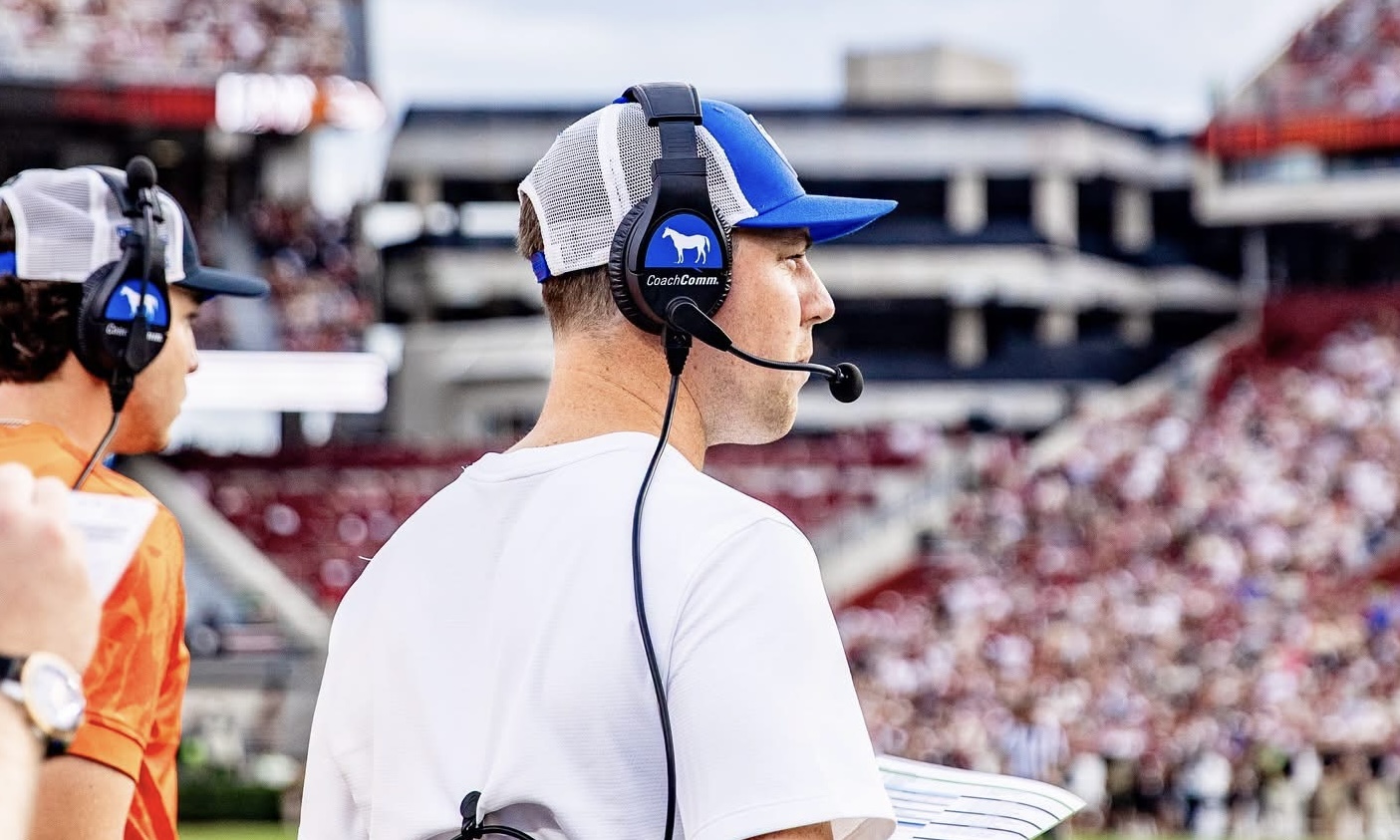
Mark Stoops’ story at Kentucky officially stopped on Monday, following an embarrassing 41-0 defeat to Louisville in the Governor’s Cup, but there was once a time Stoops could have walked away with a much different and more positive ending.
When Stoops first arrived in Lexington at the conclusion of the 2012 season, Kentucky wasn’t just struggling; they were the doormat of the SEC. Finishing 0-8 in the conference and losing to Western Kentucky the season prior, the on-field product was bad, but off the field, the facilities lagged as well.
“There will be no magic wand,” Stoops said in his introductory press conference. “We’ll be very much of a blue-collar mentality.”
Stoops got to work, as he routinely says in Monday press conferences. He tapped into his home state, into the Ohio recruiting pipeline, selling the opportunity to play football in the SEC at a time when the conference had won seven straight national titles. As a culture was built, centered around toughness and that blue-collar mentality, the motto quickly became: Why not us? Why not Kentucky?
Year by year, the bar steadily rose.
From two wins in 2013, Kentucky won five games in 2014, highlighted by a win over South Carolina, where Bud Dupree returned a late-game interception for a game-sealing touchdown. In 2016, Kentucky made its first of eight straight bowl appearances, a program record, and finished .500 in the SEC for the first time in a decade. Two more years later, the greatest season in modern program history, finishing 10-3 in 2018, with a winning record in the SEC for the first time since 1977 and a win over Penn State in the Citrus Bowl.
Stoops was creating a new reality for Kentucky football; consistently beating Missouri and South Carolina, and ending losing streaks to Florida and Tennessee. He was pushing what many believed was possible at Kentucky and encouraging fans to raise expectations. All the while staying loyal to a fanbase that isn’t used to being chosen. That is where the storybook ending would fall.
The story continued, and name, image, and likeness was introduced (NIL) to college athletics.
Stoops built Kentucky football on the identity of ‘recruit and develop’, finding overlooked recruits and turning them into NFL players. There are no better examples of that philosophy working than Benny Snell (three-star HS recruit) and Josh Hines-Allen (two-star HS recruit), who became all-time players at Kentucky, with the latter being a top-10 pick.
As NIL made its way, key staff members, including Steve Clinkscale and Jon Sumrall, who were key in player evaluation, found their ways elsewhere. Offensive line coach John Schlarmann, who was critical in building the ’Big Blue Wall,‘ sadly passed away. The administration was slow to adapt and embrace NIL, hampering the program even more.
After a 10-win season in 2021, with a roster built largely pre-NIL, the downward trend started. Bad evaluations led to players being overpaid for their production, and culture issues finding their way into the locker room. No longer was Kentucky consistently beating South Carolina and Missouri, or even Vanderbilt. They had players buying concessions midgame.
As the on-field product worsened, Stoops also began to lose the fanbase off the field. In 2022, he sent a tweet that fueled a football school-basketball school debate that became a national story. In 2023, asked disgruntled fans to “pony up” after a blowout loss to Georgia. That was echoed to him as the fanbase endured 11 straight SEC home losses.
In 2024, Kentucky was ineligible for a bowl for the first time since 2015. Meanwhile, programs of similar prestige were competing for playoff spots. In November 2025, the Wildcats lost to Vanderbilt by the largest margin since 2012, when Joker Phillips was fired.
Much like most real-life stories, Mark Stoops’ story at Kentucky did not have the perfect ending.
After 13 seasons in Lexington, Stoops stayed too long. His failure to adapt to NIL and the transfer portal ended his story. It’s also true that he was the right coach for the right time. He gave this school the two best seasons in the modern era. He ended generational streaks. He helped reset the expectations of what Kentucky football can be in the future. He left the program in a better place now than when he found it in 2012.
To me, Mark Stoops’ story at Kentucky is about a coach who poured and planted himself into a place that had little belief in winning, and in doing so, changed what Kentucky football believed it could be.
Thank you, Mark.
Related