Connect with us

Men's Basketball

Does Kentucky Struggle to Contend With Physicality, or Are They Simply Not Allowed To?

While the Wildcats stomached their third loss of the season, many spectators have called into question an uncontrollable aspect of the gam

Published

on

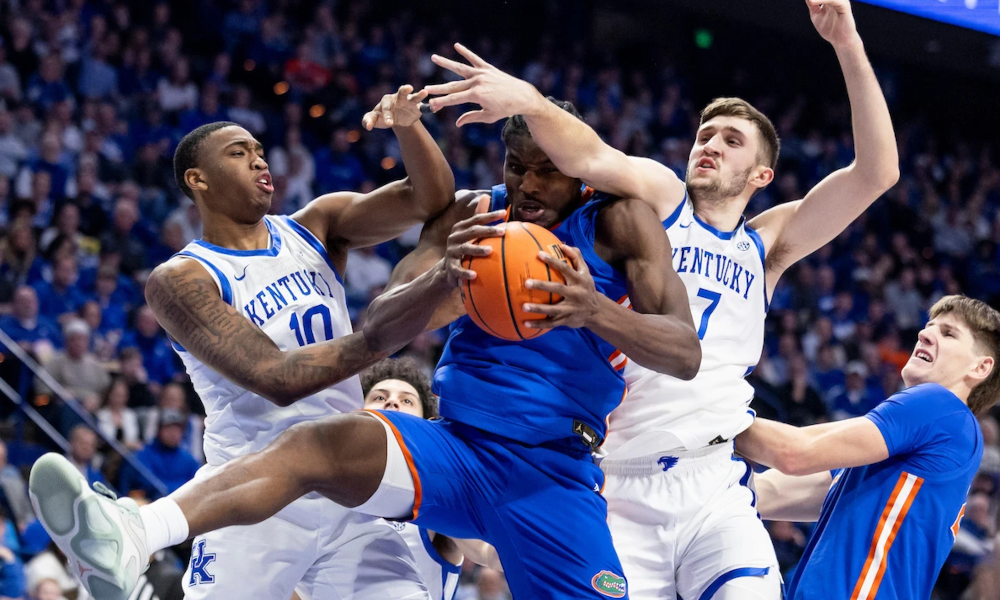
Kentucky's Brandon Garrison and Andrew Carr go up for a rebound against Florida.
Chet White | UK Athletics

In each of their three losses this year thus far, Kentucky has faced one looming criticism following the final buzzer: the inability to contend physically with their opponents.

Rebounding is a “Major Issue”

To a certain extent, this is a fair point. In wins and losses, the Wildcats have struggled to rebound the ball all season, despite holding a slight statistical advantage in that category overall. Take the recent win against Brown as a prime example, a game in which Kentucky was out-rebounded 35-29. Regardless of the 88-54 win, many folks have still stressed the glass as one of the team’s most urgent issues. Following the 82-69 loss to Georgia, wherein the Cats lost the board-battle 41-34, Coach Mark Pope and forward Andrew Carr concurred.

“It’s back-to-back games where we gave up 15 offensive rebounds… It’s unacceptable for us,” he said. “… that’s a major, major issue for us is the glass,” said Pope.

Advertisement

Carr emphasized the same, saying, “We got to get more nasty, more angry when we’re playing… get better on the defensive glass.”

So it’s safe to say that those words don’t fall on deaf ears, and in no world can, or should, Kentucky escape this argument entirely. But in the same breath, it can be fairly stated that much of the physical effort the team has shown has been immediately met with a negative whistle on either end. Many will scoff at such a suggestion, but on paper, the discrepancies are painfully apparent.

The Call-Based Catalyst

At one point during the second half of the aforementioned loss to the Bulldogs, the chasm between Kentucky’s attempts at the strike and Georgia’s was an astonishing 22; 31 to 9. Even considering a last-minute string of free throws for the visiting Wildcats, the final tally of attempts was 38 to 19 in the Bulldogs’ favor. Georgia made 29 (76%,) and Kentucky 15 (79%.)

The home team’s 38 chances at the line fell only two points shy of half their average points scored per game as a team this season, at 80.

Advertisement

On the night as a whole, Kentucky actually scored one more field goal than Georgia and made only one less three. Both teams shot below 30% from the arc and hovered around the 40% mark from the field in total. Georgia won by 13. It doesn’t take rocket science to spot the difference.

A Sour Standard

Simply put, in their matchup, Georgia wasn’t held to the same standard as Kentucky as far as the ability to play physical basketball goes. In their last two games combined, one at home and on the road respectively, and both in the SEC, Kentucky trails their opponents’ attempted free throws 43-73.

Foul numbers and free throws won’t be exactly the same for both teams, sure, but a difference as severe as that one calls for a closer look.

It’s an odd, contradictory sort of scenario, where the SEC is hailed as the toughest conference in college basketball, yet attempting to play tough lands, certain teams, most often the visiting team (or the blue team, if you will,) in a free throw hole.

Advertisement

And it isn’t just Kentucky fans who’ve taken issue with the trend.

Dan Wolken, a columnist for USA Today Sports, posted on X (Twitter) multiple times during the Kentucky-Georgia game. His first read, “If what I’m seeing tonight is an accurate representation of SEC basketball officiating, road wins should count double. Home teams getting away with some stuff.” The post was sung to the chorus of nearly 2,000 likes.

“An officiating disaster class,” he said in another. “Disgraceful stuff.”

Keep The Faith

But while the problem may be relatively easy to diagnose, a potential solution seems virtually impossible to dissect. Like every other aspect of the game, officiating is a fallible piece in the larger basketball puzzle. How, or why, it often works the way it does is unclear; all that can be said at this point is that, lately, Kentucky has consistently been given the short end of that stick.

Advertisement

One way or another they’ll have to find a way to win in spite of these disheartening stats, and if the Big Blue Nation take comfort in anything, it should be in Mark Pope and this team working tirelessly to do so.

The Cats will have a chance to bounce back in their second consecutive road game against the Bulldogs, this time taking on 24th-ranked Mississippi State. You can catch the battle on SEC Network this coming Saturday, Jan. 11th, at 8:30 p.m.

Advertisement

BB Recruiting

Kentucky Holds Zoom Call with Second-Ranked Transfer Forward Milan Momcilovic

Published

on

Kentucky hosted Iowa State transfer Milan Momcilovic — the No. 2 portal player in the country — for a Zoom meeting as he weighs an NBA Draft decision. KYInsider has the details.
IMAGN

You could make a case that Kentucky has upgraded its roster in several areas, but one area where they haven’t to this point, which has drawn criticism from Big Blue Nation, is the lack of a clear-cut star.

Of course, Kentucky fell short in the Tyran Stokes sweepstakes last week, but a new target has emerged, Iowa State transfer and the second-ranked player in the portal, Milan Momcilovic. Per sources, Kentucky held a Zoom meeting with Momcilovic and his representatives on Wednesday.

If that name sounds familiar, it should. Momcilovic torched Kentucky for 20 points, including four three-pointers, in March, sending the Wildcats home in the NCAA Tournament.

Advertisement

The 6-foot-8, 210-pound power forward is currently testing the NBA Draft waters, but is projected as an early-mid second-round selection. Meaning, there is a strong chance he would earn more money with a return to college than by keeping his name in the draft. Especially so, if the NCAA passes the “5-in-5 rule” later this month, which could give him two more seasons of eligibility.

The numbers on Momcilovic are hard to ignore. He was one of the most lethal three-point shooters in the country last season, connecting at a 48.7% clip from beyond the arc. He averaged 16.9 points and 3.1 rebounds per game, earning Second Team All-Big 12 honors.

The Wildcats may not get that highly ranked player they have been in pursuit of, but it won’t be without effort.

Advertisement

Continue Reading

Men's Basketball

Mark Pope Confirms Kentucky is Being Used for Money in NIL Negotiations, “We’re the Biggest Brand in Basketball”

Published

on

Mark Pope confirms Kentucky is "the biggest brand in basketball" — but that brand is now being used as leverage against the Wildcats in NIL negotiations. Full breakdown at KYInsider.com.
IMAGN

Kentucky is one of the biggest brands in basketball. The brand that should be one of the program’s greatest recruiting weapons is being flipped into a bargaining chip on the other side of the table.

It’s not anything new.

Under John Calipari, who brought in top-ranked recruiting classes on an annual basis, there were prospects who had Kentucky as a hat on the table, using the brand to improve the optics of their recruitment. That has continued to Mark Pope in the NIL era, but it’s not just recognition on the line; it’s millions of dollars.

Advertisement

In a social media video of him answering fan questions, Pope is aware that is the case.

“Is Kentucky being used by players to leverage for more NIL?” a fan asked.

“Yes,” Pope answered. “We [Kentucky] are the biggest brand in basketball.”

Kentucky’s struggles this offseason show that concern is more apparent now than ever, and Pope’s acknowledgment of that only reinforces the reality of the situation.

Advertisement

The question now is how Pope and Kentucky’s NIL infrastructure respond. The Cats didn’t build one of the biggest brands in college basketball over decades to watch it be used to demand a king’s ransom.

With Kentucky having one of the biggest brands in the sport, part of it comes with the territory; it’s up to the staff to have a better read on recruitments and agent tactics. It’s too late to have an impact this offseason, but hiring someone experienced in agent negotiations and well-versed in NIL and the realities of modern college sports is necessary going forward.

Advertisement
Continue Reading

BB Recruiting

From Senegal to Lexington, Getting to Know Kentucky’s International Commitment Ousmane N’Diaye

Published

on

Discover Ousmane N’Diaye’s journey to Kentucky basketball, from Senegal to Lexington, his development, and what he brings to the Wildcats.

Ousmane N’Diaye, a 22-year-old prospect from Dakar, Senegal, has been on NBA Draft boards for the better part of a decade now, and his next stop is Lexington. Though the 6-10 player you see today, who is skilled, mobile, and comfortable on the perimeter, came far from a traditional basketball environment.

Born in Guédiawaye, a densely populated suburb of Dakar, the capital of Senegal, which faces significant infrastructure challenges, flooding, and poverty, N’Diaye grew up against the odds. What he lacked in material things, he gained through traditional Senegalese values, one of the most important being respect for elders. That value has helped shape his drive today, fueled by the women who mean the most to him, his mother and his grandmother.

“His main motivation is his mother and especially his grandmother,” Seydina Aboubakeur Ba said of N’Diaye, a trainer who has known him since he was a young boy. “He deeply wishes for his grandmother to witness his success, as she has always been there for him through both good and difficult times.”

Advertisement

Ba has known N’Diaye since he was 12 years old, when he helped discover and invite him to join DIEDA Basketball Academy (DBA) in Dakar, a respected player development program in West Africa. The program has helped send multiple players to D1 college programs and professional European clubs.

Shortly after joining, the Academy helped N’Diaye attend a Basketball Without Borders (BWB) Africa Camp in Angola, where former Wildcat Eric Bledsoe was an instructor.

When he first arrived at DBA, the potential was evident: great size, a natural feel for the game, and a motor that coaches could work with, creating the foundation for his growth.

“Over time, the program helped him significantly develop his shooting ability and transform into a versatile player,” Ba said. “Despite his height, he began to develop like a wing, handle the ball effectively, and move comfortably on the perimeter.”

Advertisement

That kind of versatility in a near 7-foot frame helped N’Diaye garner attention from European clubs.

In 2019, he began to play professionally, starting with Dragons Rhoendorf, a German professional club that competes in the country’s third-highest division. While playing for Rhoendor in 2020, ESPN highlighted a then-15-year-old N’Diaye as “one of the best long-term prospects we evaluated” following a Basketball Without Borders Global Camp in Chicago, playing against the likes of current/former NBA players Josh Giddey and Josh Primo.

After three seasons with them, N’Diaye moved to Saski Baskonia, which plays in Spain’s top division, Liga ACB. This past season, he played for the Italian club, Vanoli Cremona, in the LBA, Italy’s top basketball league. There, he averaged 10.2 points and 6.7 rebounds on 32% shooting from three.

When asked which NBA player N’Diaye models his game after, Ba, without hesitation, answered Kevin Durant. An audacious comparison, but one that embodies modern basketball, which is increasingly demanding for bigs to be able to function on the perimeter, stretch defenses, and create problems in space. That suits N’Diaye’s playstyle.

Advertisement

While N’Diaye has been playing basketball for a decade, he’s facing some of the most fundamentally sound opponents in Europe, which shows. Undrafted in the 2025 NBA Draft, there are certainly weaknesses to his game.

“Ousmane still needs to further develop his low-post game,” Ba acknowledges. “He needs to improve certain aspects of his defense in order to become a true franchise player at the highest level.”

The biggest knock on N’Diaye is his poor decision-making at times, but it may be due to his role.

“The context behind his rushed decision-making is trying to be a spark off the bench in limited minutes and ball touches,” international scout Ersin Demir explains. “N’Diaye’s lack of composure takes away the capability to execute easy reads.”

Advertisement

At Kentucky, both N’Diaye and head coach Mark Pope see an opportunity to refine those areas to help him make the move to the highest level in basketball.

“His biggest strength is his desire to be the best,” Ba explains. “He responds very well to coaching. He is a disciplined player who listens carefully and also likes to engage with his coach to better understand and improve. When it comes to criticism, he accepts it.”

With NBA aspirations, N’Diaye remains grounded. “A very simple and humble person,” Ba explains. “Quite shy, who enjoys staying in his own space and building a quiet world around himself.”

As for a message to Kentucky fans, “Give him a lot of love, and I’m sure he will give it back.”

Advertisement

From poverty-stricken Guédiawaye to the biggest stage in college basketball, N’Diaye is a success and is still writing his story.

Continue Reading

Trending