
Men's Basketball
Flop or Flagrant Foul: Immanuel Quickley and Yves Pons

For the first time ever, I attended Thompson-Boling Arena yesterday for the Kentucky vs. Tennessee game. The arena is nice, the fans I sat around were nice, and the game was fun. Some drunk Vol fans were chanting “f*** Kentucky!” and talking trash about Lexington when we left, but otherwise, it was a fun experience.
One thing that has been consistently terrible in college basketball this season, well other than North Carolina, is college officials.
I didn’t think they were terrible in yesterday’s slate of games, but there were two egregious no-calls. One in the UT/UK game and one in the Duke/UNC game. One cost a team the game, the other didn’t, but one was much worse than the other.
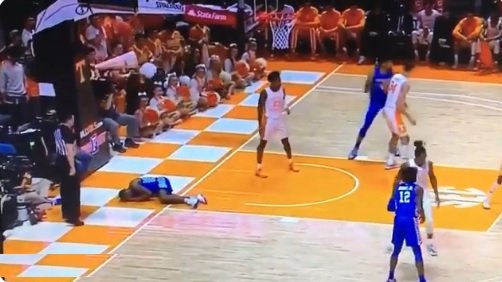
I didn’t see the play happen live, all I saw was Immanuel Quickley lying on the ground and he appeared to be unconscious because he wasn’t moving. The refs didn’t even blow the play dead and finally John Calipari got the refs attention and walked out onto the floor. The refs wouldn’t let him on the floor at first but Cal won the battle as he walked out with Vol fans erupting in boo’s.
Should they have stopped play? Yes. Kentucky had possession and the ref was literally right there when it happened. Instead, all he did was shake his head.
I woke up this morning to see a lot of fans suggesting that Quickley flopped and that it was a good no-call. I couldn’t believe it. So let’s break it down.
Quickley isn’t even looking
It’s pretty clear that Kentucky is running a play to get Quickley open. No one else is moving besides him and Keion Brooks is setting a screen for him.
The thing that makes this even weirder is that Tennessee is on defense. Why on earth is Pon trying to set a screen? If he is simply trying to keep Quickley from running the baseline, this isn’t the legal way to do it.
Not set and leans in
If you watch the video closely, Pons isn’t close to set. He’s moving before he gets in front of Quickley and he clearly leans his shoulder in Quickley’s direction before they make contact.
I know one photo doesn’t do the play justice, but here’s the moment of impact.

Shoulder
I pretty much already stated this above, but I need to emphasize it a little more. Pons clearly sticks his shoulder out toward Quickley before they make contact. I wouldn’t really have a problem if he just moved laterally to get in front of him, but he clearly swings his shoulder at Quickley, making it even worse, and a dirty play.
The Ref
To cap it all off, there’s a ref standing right there and he does nothing. In the background, Nick Richards sees the play and goes nuts, the refs simply shakes his head, suggesting there’s nothing. I don’t know how you can see that in live action and do nothing.
Flagrant Two
This is clearly a Flagrant Two foul and Pons should’ve been thrown out of the game. He swung his shoulder at Quickley and made contact above the shoulder area. The play was completely unnecessary and wasn’t anywhere near the ball. Like I said, it looked like Quickley got knocked out because he went to the ground and didn’t move and was there for a lengthy amount of time.
For the ref not to even blow his whistle is absurd. There’s no way that’s a clean play in basketball. I would go as far as saying the ref should be suspended. He watches the play, doesn’t blow his whistle, shakes his head, and doesn’t stop play for an injured player on the team with possession of the ball (the rule).
After the game, Quickley tweeted this:
And to make it even better, the blind mouse that missed that made this call:
Don’t get me wrong, the refs made some bad calls on both teams. But, like I said above, unless your a homer who hates UK, this is an obvious foul call and an ejectable foul. No way is this a play on.
Thanks SEC refs.






Kentucky Football Takes Care of Business, Defeats South Alabama

Minchey Mayweather: The Coolest Cat in College Football

Kentucky Football Jumps 15 Spots in ESPN’s Football Power Index

Asia Thigpen Shares How Kentucky Can Maintain Intensity Continuing Conference Play

No. 3 Kentucky Volleyball Sweeps the No. 7 Texas Longhorns, Moves to 2-0 in SEC

Kentucky Football’s Injury Report Features 10 Injured Wildcats Ahead of LSU Matchup

Kentucky’s Kenny Darby Tabbed as a Freshman Standout

Kentucky Competes at Annual Pro Day Inside of Rupp Arena

Mark Pope Gives Update on Vacant Roster Spot, Potential Coaching Addition

2028 Defensive Lineman Kellan Hall Receives Prediction to Kentucky Football
-
 Football2 weeks ago
Kentucky Football Takes Care of Business, Defeats South Alabama
-
 Football2 weeks ago
Minchey Mayweather: The Coolest Cat in College Football
-
 Football2 weeks ago
Kentucky Football Jumps 15 Spots in ESPN’s Football Power Index
-
 Other Sports1 week ago
Asia Thigpen Shares How Kentucky Can Maintain Intensity Continuing Conference Play
-
 Other Sports2 weeks ago
No. 3 Kentucky Volleyball Sweeps the No. 7 Texas Longhorns, Moves to 2-0 in SEC
-

 Football1 week ago
South Carolina’s Dylan Stewart Suspended – How Does This Affect Will Stein and Kentucky?
-

 Other Sports1 week ago
Kentucky Men’s Golf Ties For 9th at Windon Memorial Classic With Season-Best Team Total
-

 Men's Basketball1 week ago
New Injury Developments Arise During 2026 Kentucky Media Day